

Old vs New Tax Regime Calculator: Which Is Better for FY 2026-27? (Complete Slabs & Surcharge Guide)
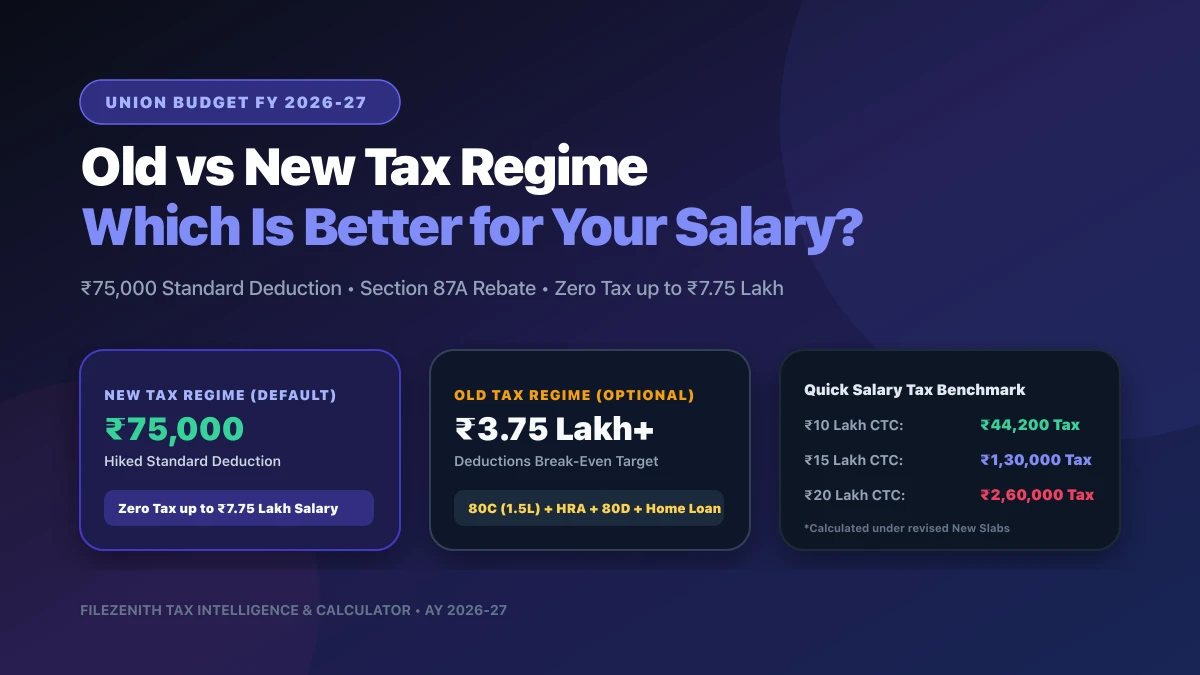
Compare Old vs New Tax Regime for FY 2026-27 (AY 2027-28). Analyze ₹75,000 standard deduction, Section 87A rebate, tax slabs, and break-even deduction targets.
Reviewed by FileZenith Editorial Board
Fact-Checked for Official 2026-27 Notification Standards
Dimensions, file size rules, and accepted formats are verified against current SSC, UPSC, NTA, and State PSC guidelines. Zero-server guarantee: images and signatures are processed locally inside your web browser.
Use Tool Directly in Browser
Your files never leave your browser. 100% free, zero login required.
Every year between April and June, millions of salaried employees face a crucial declaration form on their corporate payroll portals (Darwinbox, Workday, ZingHR, greytHR):
"Select your Tax Regime for the Financial Year: [ ] New Tax Regime (Default) or [ ] Old Tax Regime. Failure to submit declaration by the cut-off date will automatically lock your payroll into the default New Tax Regime."
Making the wrong selection can easily cost you ₹30,000 to over ₹1,20,000 in excess TDS deductions over the financial year!
With recent Union Budget updates introducing a hiked ₹75,000 Standard Deduction for salaried taxpayers and restructuring the concessional tax slabs under Section 115BAC, the New Tax Regime has become overwhelmingly attractive for middle-income earners. However, if you are servicing a heavy home loan, paying steep metro rent via HRA, or funding family medical insurance, the Old Tax Regime may still deliver massive tax savings.
In this comprehensive guide, we provide the definitive tax slab comparison for FY 2026-27 (AY 2027-28), calculate the exact deduction break-even threshold, compare real tax liabilities across 6 salary brackets, and show you how to identify your optimal regime in seconds using our free online calculator.
Complete Tax Slab Comparison: FY 2026-27 (AY 2027-28)#
Under the revised Income Tax Act rules, the New Tax Regime is the default regime for all individual taxpayers. If you wish to claim traditional exemptions (HRA, 80C, 80D), you must explicitly opt into the Old Tax Regime.
Here is the side-by-side tax slab breakdown:
| Income Slab Range | Old Tax Regime Rate | Revised New Tax Regime (Sec 115BAC) |
|---|---|---|
| ₹0 to ₹2,50,000 | Nil (0%) | Nil (0%) |
| ₹2,50,001 to ₹3,00,000 | 5% (Rebate available up to ₹5L) | Nil (0%) |
| ₹3,00,001 to ₹7,00,000 | 5% (Above ₹5L: 20%) | 5% |
| ₹7,00,001 to ₹10,00,000 | 20% | 10% |
| ₹10,00,01 to ₹12,00,000 | 30% | 15% |
| ₹12,00,001 to ₹15,00,000 | 30% | 20% |
| Above ₹15,00,000 | 30% | 30% |
| Salaried Standard Deduction | ₹50,000 | ₹75,000 (Hiked) |
| Section 87A Tax Rebate | Full tax rebate up to ₹5,00,000 taxable income | Full tax rebate up to ₹7,00,000 taxable income |
| Effective Zero-Tax Threshold | ₹5,50,000 gross salary | ₹7,75,000 gross salary |
Note on Cess: A mandatory 4% Health & Education Cess is added to the computed tax liability under both regimes. Surcharge applies to taxable incomes exceeding ₹50 Lakh.
The Break-Even Deduction Threshold: When Does Old Regime Beat New?#
The golden question for every taxpayer is: “How much total deduction do I need to make the Old Tax Regime better than the New Tax Regime?”
Because the New Regime offers lower baseline tax rates and a higher ₹75,000 standard deduction without locking your capital in lock-in schemes, the Old Regime only wins if your total itemized deductions cross a specific mathematical break-even point:
| Gross Annual Salary (CTC) | Total Eligible Deductions Required for Old Regime to Win | Typical Deductions Package Required |
|---|---|---|
| ₹8,00,000 | ₹2,65,000 | 80C (₹1.5L) + HRA (₹1.15L) |
| ₹10,00,000 | ₹3,15,000 | 80C (₹1.5L) + HRA (₹1.2L) + 80D (₹45k) |
| ₹12,50,000 | ₹3,60,000 | 80C (₹1.5L) + HRA (₹1.5L) + 80D + 80CCD(1B) |
| ₹15,00,000 | ₹3,75,000 | 80C (₹1.5L) + Home Loan Interest (₹2L) + 80D |
| ₹20,00,000 | ₹3,95,000 | 80C (₹1.5L) + Home Loan (₹2L) + 80D (₹50k) |
| ₹30,00,000+ | ₹4,25,000+ | Full 80C + Max HRA + Home Loan + Med Insurance |
The General Rule of Thumb: If your total deductions (including 80C, HRA, home loan interest, and health insurance) are less than ₹3,50,000 to ₹3,75,000, the New Tax Regime is almost always better and saves you substantial tax without locking your funds in 5-year lock-in instruments.
Head-to-Head Tax Liability Matrix: Real Salary Examples#
Let's evaluate the exact tax payable across common gross salary tiers, assuming a standard deduction of ₹75,000 (New) vs. ₹50,000 + ₹1.5L (80C) + ₹50k (80D) = ₹2,50,000 deductions (Old):
| Gross Annual Salary | Old Regime Tax (with ₹2.5L deductions) | New Regime Tax (Default) | Winning Regime | Annual In-Pocket Savings |
|---|---|---|---|---|
| ₹7,50,000 | ₹0 (Rebate Sec 87A) | ₹0 (Rebate Sec 87A) | Tied (Nil) | Zero tax in both |
| ₹7,75,000 | ₹6,500 | ₹0 (₹75k Standard Ded) | New Regime | Save ₹6,500 |
| ₹10,00,000 | ₹65,000 | ₹44,200 | New Regime | Save ₹20,800 |
| ₹12,50,000 | ₹1,17,000 | ₹80,600 | New Regime | Save ₹36,400 |
| ₹15,00,000 | ₹1,74,200 | ₹1,30,000 | New Regime | Save ₹44,200 |
| ₹20,00,000 | ₹3,30,200 | ₹2,60,000 | New Regime | Save ₹70,200 |
| ₹30,00,000 | ₹6,42,200 | ₹5,72,000 | New Regime | Save ₹70,200 |
Note: Computations include applicable 4% Health & Education Cess. Old regime tax reflects ₹2.5 Lakh total deduction. If Old Regime deductions exceed ₹4 Lakh, Old Regime yields greater savings at higher brackets.
How to Calculate Your Tax Using FileZenith#
Using the FileZenith Income Tax Calculator, you can compare your personalized tax liability side-by-side without entering personal bank details or phone numbers:
- Open the FileZenith Income Tax Calculator (Old vs New).
- Enter your Gross Annual Salary / Total Income (e.g.
₹12,00,000). - Enter your eligible exemptions under the Old Regime:
- Section 80C: EPF, PPF, ELSS mutual funds, Life Insurance, Children Tuition Fees (Up to ₹1,50,000).
- House Rent Allowance (HRA): Exempt rental amount under Section 10(13A).
- Section 80D: Health Insurance premium for self and parents (Up to ₹25,000 / ₹50,000).
- Section 24(b): Home Loan interest on self-occupied house property (Up to ₹2,00,000).
- Section 80CCD(1B): Additional NPS contribution (Up to ₹50,000).
- Review the Side-by-Side Tax Comparison Graph. The tool automatically identifies the winning regime and displays your net take-home tax savings.
- Download or print the detailed slab-by-slab computation breakdown for submitting proof to your HR department.
5 Crucial Tax-Saving Strategies & Pitfalls to Avoid#
- The Section 87A Marginal Relief Trap: Under the New Regime, if your taxable income after the ₹75,000 standard deduction is ₹7,00,000, your tax is ₹0. However, if your taxable income is ₹7,05,000, marginal relief ensures you only pay tax equal to the income exceeding ₹7,00,000.
- Switching Frequency for Salaried vs. Business Income: Salaried employees have the freedom to switch between the Old and New Tax Regimes every single financial year when filing their ITR (Income Tax Return). However, individuals with business or professional income (ITR-3 / ITR-4) can switch out of the New Regime only once in their lifetime!
- Loss of Set-Off on Let-Out Property in New Regime: Under the Old Regime, you could set off up to ₹2,00,000 of loss from house property against your salary income. Under the New Regime, interest on let-out house property cannot be adjusted against salary income.
- Liquidity vs. Tax Saving in Section 80C: In the Old Regime, people often lock ₹1,50,000 in low-return traditional endowment insurance policies just to save ₹30,000 in tax. Under the New Regime, you can keep that ₹1.5 Lakh liquid or invest it in high-return index funds or monthly SIPs.
- Corporate NPS (Section 80CCD(2)) is Allowed in Both Regimes: Many employees assume all deductions are eliminated in the New Regime. In reality, Employer’s contribution to NPS (up to 14% of Basic for Central Govt / 10% for Private Sector) is fully tax-free under BOTH regimes!
Real-World Case Study: An IT Professional with Home Loan & HRA#
Taxpayer: Vikram Singhania, Senior Lead Engineer (Bengaluru)
Gross Salary (CTC): ₹16,50,000 per annum
Deductions Available:
- Section 80C (EPF + ELSS): ₹1,50,000
- Section 24(b) Home Loan Interest: ₹1,80,000
- Section 80D Health Insurance: ₹30,000
- Standard Deduction: ₹50,000 (Old) vs ₹75,000 (New)
The Calculation:
- Under New Regime: Net Taxable Income = ₹16,50,000 - ₹75,000 = ₹15,75,000.
- Computed Tax: ₹1,50,000 (up to 15L) + 30% of ₹75,000 (₹22,500) = ₹1,72,500 + 4% cess = ₹1,79,400.
- Under Old Regime: Total Deductions = ₹50,000 + ₹1,50,000 + ₹1,80,000 + ₹30,000 = ₹4,10,000.
- Net Taxable Income = ₹16,50,000 - ₹4,10,000 = ₹12,40,000.
- Computed Tax = ₹1,12,500 (up to 10L) + 30% of ₹2,40,000 (₹72,000) = ₹1,84,500 + 4% cess = ₹1,91,880.
The Verdict: Even with ₹3,60,000 in heavy itemized deductions and home loan interest, the New Tax Regime saved Vikram ₹12,480 in pure cash because the Old Regime’s steep 30% tax bracket kicks in immediately above ₹10 Lakh! Vikram opted for the New Regime on his company portal.
Frequently Asked Questions (FAQ)#
What is the standard deduction for salaried employees in FY 2026-27?
For Financial Year 2026-27 (Assessment Year 2027-28), the standard deduction under the New Tax Regime is ₹75,000 (hiked from ₹50,000). Under the Old Tax Regime, the standard deduction remains ₹50,000.
Up to what salary is income tax zero under the New Tax Regime?
Under the New Tax Regime, salaried individuals pay zero tax on a gross salary up to ₹7,75,000. This includes the ₹75,000 standard deduction (bringing taxable income down to ₹7,00,000) and the full tax rebate granted under Section 87A.
Can salaried employees change their tax regime while filing ITR?
Yes! Even if you declared the New Tax Regime to your employer at the beginning of the financial year and TDS was deducted accordingly, you can switch to the Old Tax Regime (or vice versa) while filing your annual Income Tax Return (ITR-1 or ITR-2) before the official deadline.
Is HRA exemption allowed in the New Tax Regime?
No. House Rent Allowance (HRA) exemption under Section 10(13A) is not permitted under the New Tax Regime. HRA can only be claimed if you opt for the Old Tax Regime.
Which regime is better for a ₹10 Lakh annual salary?
For an annual salary of ₹10,00,000, the New Tax Regime is significantly better for most taxpayers. Under the New Regime, total tax liability is only ₹44,200. Under the Old Regime, you would need over ₹3,15,000 in total deductions just to break even with this amount.
Related Financial Calculators & Tools#
- Income Tax Calculator (Old vs New) — Calculate exact tax savings and slab breakdown for FY 2026-27.
- CTC to In-Hand Salary Calculator — Calculate your exact monthly take-home salary after PF, PT, and TDS.
- SIP Return Calculator — Discover future compounding returns for wealth creation in mutual funds.
- EPF Balance Growth Calculator — Compute retirement maturity at the current EPFO 8.25% interest rate.
- EMI Loan Calculator — Plan home loan and personal loan monthly EMIs and interest amortization.
Explore Related FileZenith Tools
- Complete Tax Slab Comparison: FY 2026-27 (AY 2027-28)
- The Break-Even Deduction Threshold: When Does Old Regime Beat New?
- Head-to-Head Tax Liability Matrix: Real Salary Examples
- How to Calculate Your Tax Using FileZenith
- 5 Crucial Tax-Saving Strategies & Pitfalls to Avoid
- Real-World Case Study: An IT Professional with Home Loan & HRA
- Frequently Asked Questions (FAQ)
- Related Financial Calculators & Tools