

How to Calculate Electricity Bill from Meter Reading: Slabs, Tariff Formula & Subsidy Guide
Master how to calculate your electricity bill from meter reading (kWh). Complete breakdown of telescopic slab tariffs, fixed charges, fuel surcharges, and state subsidies (Delhi, Maharashtra, UP, Karnataka).
Reviewed by FileZenith Editorial Board
Fact-Checked for Official 2026-27 Notification Standards
Dimensions, file size rules, and accepted formats are verified against current SSC, UPSC, NTA, and State PSC guidelines. Zero-server guarantee: images and signatures are processed locally inside your web browser.
Use Tool Directly in Browser
Your files never leave your browser. 100% free, zero login required.
Have you ever opened your monthly electricity bill, looked at the final payable amount, and wondered: "Did the discom meter reader overcharge me? How did my bill reach ₹4,500 when I barely used the air conditioner?"
For millions of households, tenants, and shop owners across India, electricity bills feel like a cryptic puzzle of confusing acronyms: kWh, MDI, FAC, FPPCA, Fixed Charges, Telescopic Slabs, and Electricity Duty.
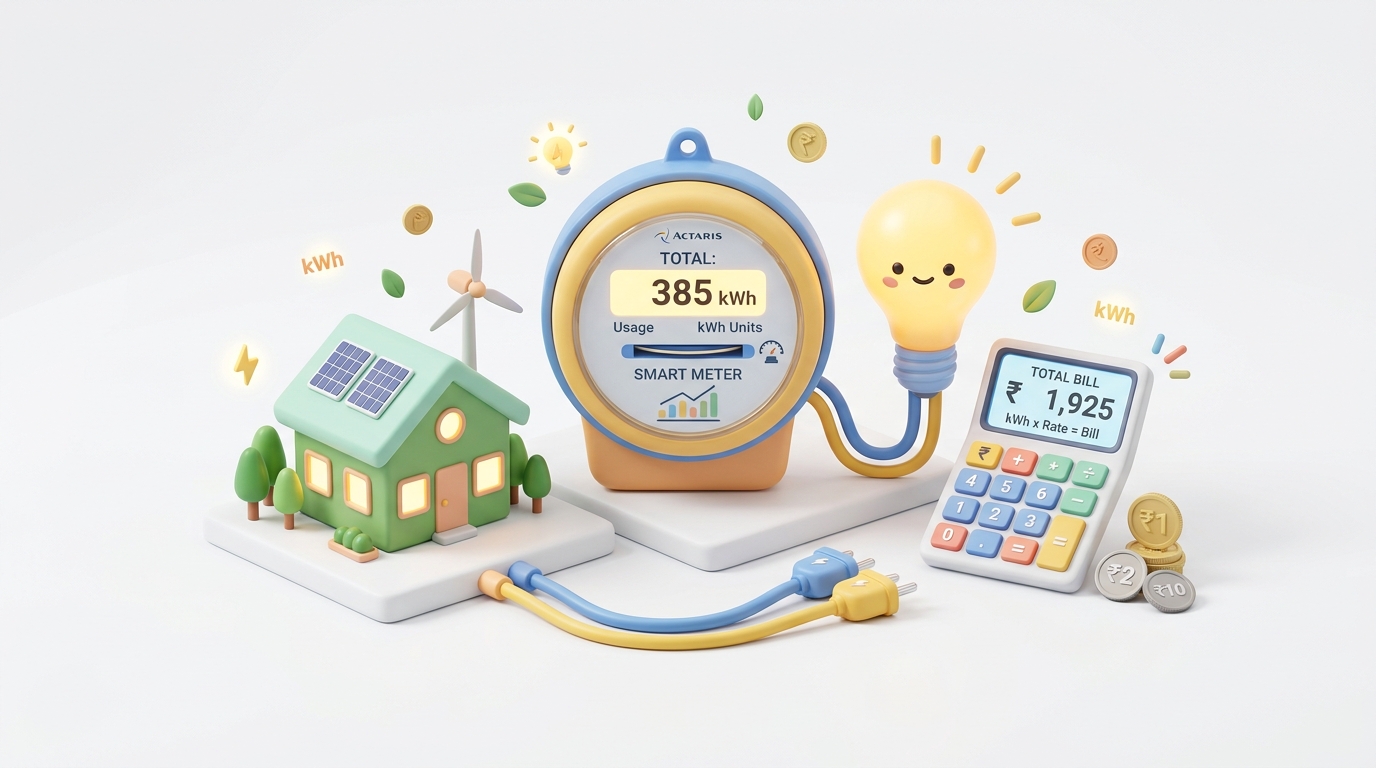
The truth is that calculating your electricity bill from your digital smart meter or traditional electronic meter is straightforward once you understand the underlying mathematics of tiered slab tariffs.
In this practical, zero-fluff handbook, we teach you how to read your digital electricity meter, the exact step-by-step mathematical formula used by distribution companies (DISCOMs), state-wise slab tariffs (including Maharashtra, Delhi, UP, Karnataka), how government subsidies are calculated, and how to verify your bill in seconds with FileZenith's free Electricity Bill Calculator.
What Exactly is "1 Unit" of Electricity?#
Before touching any formulas, you need to understand what you are being billed for.
In electrical engineering and utility billing:
1 Unit of Electricity = 1 Kilowatt-hour (kWh) = 1,000 Watt-hours
This means if you consume 1,000 watts of electrical power continuously for 1 hour, your meter logs exactly 1 unit.
Quick Everyday Real-World Equivalents of 1 Unit:
- A 10-watt LED bulb running for 100 hours (10W x 100h = 1,000 Wh).
- A 75-watt ceiling fan spinning at top speed for 13.3 hours (75W x 13.3h ≈ 1,000 Wh).
- A 1.5-ton 5-star inverter AC (averaging ~900 watts running load) running for ~1.1 hours.
- A 2,000-watt immersion rod or geyser running for just 30 minutes (2,000W x 0.5h = 1,000 Wh).
The Step-by-Step Formula: How Electricity Bills are Calculated#
Your total monthly bill consists of four primary components:
Total Payable Bill = Energy (Slab) Charges + Fixed Demand Charges + Fuel Surcharge (FAC / FPPCA) + Electricity Duty / Tax
Let's break down each step:
Step 1: Find Units Consumed from Your Meter Reading
Digital meters display cumulative units consumed since installation. You need two numbers:
- Current Month Reading: Note the reading with the
kWhindicator on your meter screen. - Previous Month Reading: Found on last month's paid bill.
Units Consumed = Current Reading - Previous Reading
Example: If your meter read 04320 kWh on August 1st and reads 04640 kWh on September 1st:
- Units Consumed = 4,640 - 4,320 = 320 units
Step 2: The "Telescopic Slab" Magic (Why Higher Tiers Don't Penalize Everything)
The biggest misconception in electricity billing is assuming: "If my bill entered the ₹8/unit slab, will all my units be billed at ₹8?"
No! Indian DISCOMs follow a telescopic slab structure. Your consumption is sliced into brackets, and each bracket is billed at its respective rate.
Typical Domestic Slab Example:
- First 100 units (0 to 100): ₹3.50 / unit
- Next 200 units (101 to 300): ₹5.80 / unit
- Next 200 units (301 to 500): ₹7.50 / unit
- Above 500 units: ₹9.20 / unit
If you consume 250 units, your energy charge is:
- First 100 units x ₹3.50 = ₹350
- Remaining 150 units x ₹5.80 = ₹870
- Total Energy Charge = ₹350 + ₹870 = ₹1,220 (Not 250 x ₹5.80 = ₹1,450!).
Step 3: Fixed Charges (Sanctioned Load)
Every consumer pays a monthly fixed charge based on their sanctioned / connected load (in kW), regardless of whether you consume any power.
- Standard domestic load in apartments: 2 kW to 5 kW.
- Typical charge: ₹50 to ₹150 per kW per month.
- If your connected load is 3 kW at ₹80/kW, your fixed charge is ₹240.
Step 4: Fuel Surcharge (FAC / FPPCA) and State Electricity Duty
- FPPCA / FAC (Fuel Price Adjustment): Coal and gas price fluctuations incurred by power generation stations are passed on as a variable surcharge (typically ₹0.20 to ₹0.85 per unit).
- Electricity Duty (ED): State government tax, either a flat rate per unit (e.g., ₹0.15/unit) or a percentage of the energy bill (typically 5% to 16% depending on state legislation).
State-Wise Slabs & Subsidies Comparison Table#
Here is how major state distribution companies calculate domestic bills in 2026-2027:
| State & DISCOM | Slabs & Rates (Indicative Domestic) | Fixed Monthly Charge | Special Subsidy Scheme |
|---|---|---|---|
| Delhi (BSES / TPDDL) | 0-200: ₹3.00, 201-400: ₹4.50, 401-800: ₹6.50, Above 800: ₹7.00 | ₹20 to ₹140 / kW | 100% Free up to 200 units; 50% Subsidy (up to ₹800) for 201-400 units (opt-in) |
| Maharashtra (MSEDCL) | 0-100: ₹4.71, 101-300: ₹10.29, 301-500: ₹14.55, Above 500: ₹16.64 | ₹128 to ₹470 / month | No general domestic subsidy; progressive steep upper slabs |
| Uttar Pradesh (UPPCL) | 0-150: ₹5.50, 151-300: ₹6.00, 301-500: ₹6.50, Above 500: ₹7.00 | ₹110 / kW / month | Subsidies provided to rural unmetered/metered connections |
| Karnataka (BESCOM) | Single / Telescopic slab: ~₹4.75 - ₹7.00 / unit | ₹70 to ₹100 / kW | Gruha Jyothi Scheme: Up to 200 units free for eligible domestic households |
| Tamil Nadu (TANGEDCO) | 0-100: ₹0 (Free for all), 101-200: ₹2.25, 201-400: ₹4.50 | Flat bi-monthly | First 100 units free bi-monthly for all domestic consumers |
Real Calculation Walkthrough: Delhi vs Maharashtra for 280 Units#
Let’s calculate the bill for a household consuming 280 units in a 30-day month with a 2 kW sanctioned load:
Scenario A: Delhi Consumer (with Opted Subsidy)
- Units Consumed: 280 units (falls in 201–400 bracket).
- Gross Energy Charge:
- First 200 units x ₹3.00 = ₹600
- Next 80 units x ₹4.50 = ₹360
- Energy subtotal = ₹960
- Fixed Charge (2 kW): ₹40 x 2 = ₹80
- Gross Bill before subsidy: ₹960 + ₹80 = ₹1,040
- Delhi 50% Subsidy Deduction: -₹520
- Total Payable: ≈ ₹520 + taxes (Under ₹600 total).
Scenario B: Maharashtra Consumer (MSEDCL)
- Units Consumed: 280 units.
- Energy Charges:
- First 100 units x ₹4.71 = ₹471
- Next 180 units x ₹10.29 = ₹1,852.20
- Energy subtotal = ₹2,323.20
- Fixed Charge: ₹128
- FAC (₹0.35/unit): 280 x 0.35 = ₹98
- Electricity Duty (16%): ≈ ₹400
- Total Payable: ≈ ₹2,950 to ₹3,050.
Notice how the same 280 units cost ₹600 in Delhi due to subsidies, but ~₹3,000 in Maharashtra due to higher base tariffs and duties!
Appliance Wattage Guide: What Consumes the Most Power?#
To reduce your electricity bill, prioritize curbing the heavy energy hogs:
| Appliance | Rated Power (Watts) | Average Daily Usage | Monthly Units (kWh) | Monthly Cost (@ ₹7/unit) |
|---|---|---|---|---|
| 1.5 Ton Split AC (3-Star) | 1,500 W (avg 900W) | 8 hours | 216 units | ₹1,512 |
| Water Geyser (Storage) | 2,000 W | 1 hour | 60 units | ₹420 |
| Frost-Free Refrigerator (260L) | 250 W (compressor cycle) | 24 hours (8h run) | 45 units | ₹315 |
| Ceiling Fans (x 3) | 75 W each = 225 W | 14 hours | 94.5 units | ₹661 |
| 55-inch 4K LED TV | 120 W | 5 hours | 18 units | ₹126 |
| Automatic Washing Machine | 500 W | 1 hour | 15 units | ₹105 |
💡 Quick Saving Tip: Increasing your air conditioner temperature from 18°C to 24°C saves up to 24% to 30% of your AC power consumption, reducing your bill by hundreds of rupees each month.
How Solar Rooftop Net Metering Affects Your Bill#
If you have installed a grid-tied rooftop solar system (under PM Surya Ghar Muft Bijli Yojana), your meter is replaced with a bi-directional Net Meter:
Net Billed Units = Imported Units (from Grid) - Exported Units (from Solar)
- If your home imported 350 units from the grid at night, but your solar rooftop exported 400 units during the day, your Net Units Consumed = 0.
- You only pay the minimum fixed demand charges (or receive a credit balance roll-over to the next month).
Calculate Your Bill Instantly with FileZenith#
Stop guessing or doing manual arithmetic! Use our free online Electricity Bill Calculator:
- Select your State (Maharashtra, Delhi, UP, Karnataka, Tamil Nadu, Gujarat, or Custom Slabs).
- Enter previous and current meter readings (or total consumed units).
- Add appliance wattage breakdown to simulate where your energy is being spent.
- Deduct solar net exports and view instant savings.
Frequently Asked Questions (FAQ)#
How do I check if my electricity meter is running too fast?
Turn off all main circuit breakers and appliances inside your home for 15 minutes. Check if the red pulsing LED light on your meter continues to blink. If the meter logs units while all appliances are switched off, there is either wiring leakage or a faulty meter requiring DISCOM inspection.
What is the difference between kW and kWh on the electricity meter?
kW (Kilowatt) represents Power / Demand (how much electricity you are drawing at that exact second). kWh (Kilowatt-hour) represents Total Energy Consumed over time (units). You are billed primarily on cumulative kWh.
Is the Delhi 200 unit free electricity subsidy automatic?
No. In Delhi, consumers must submit an electricity subsidy opt-in form (via WhatsApp or the DISCOM web portal) once per year to receive the 100% waiver up to 200 units or 50% subsidy up to 400 units.
Why is my first electricity bill after moving into a new house so high?
New connections often include non-recurring security deposits, meter installation fees, and an initial full-cycle fixed charge before telescopic usage stabilizes.
Can I calculate my electricity bill before the bill arrives?
Yes! Simply subtract the previous month's final reading shown on your last bill from the current reading displayed on your meter screen, and enter the units into our Electricity Bill Calculator along with your state slab.
Explore Related FileZenith Tools
- What Exactly is "1 Unit" of Electricity?
- The Step-by-Step Formula: How Electricity Bills are Calculated
- State-Wise Slabs & Subsidies Comparison Table
- Real Calculation Walkthrough: Delhi vs Maharashtra for 280 Units
- Appliance Wattage Guide: What Consumes the Most Power?
- How Solar Rooftop Net Metering Affects Your Bill
- Calculate Your Bill Instantly with FileZenith
- Frequently Asked Questions (FAQ)